Published: 11 November 2025
Introduction
Ad copywriting is the engine that powers modern digital advertising. Whether you’re launching your first campaign or refining existing ads, the words you choose determine how many people click and convert. Recent Google guidelines stress that helpful, people‑first content with clear authorship and transparent production should be your guiding principle.
This guide blends those principles with practical tactics for writing effective Google and Facebook ads in 2025. You’ll find concise explanations, templates, a visual example and a hypothetical performance chart to help you write copy that resonates with readers and search engines.
Google Ads vs. Facebook Ads
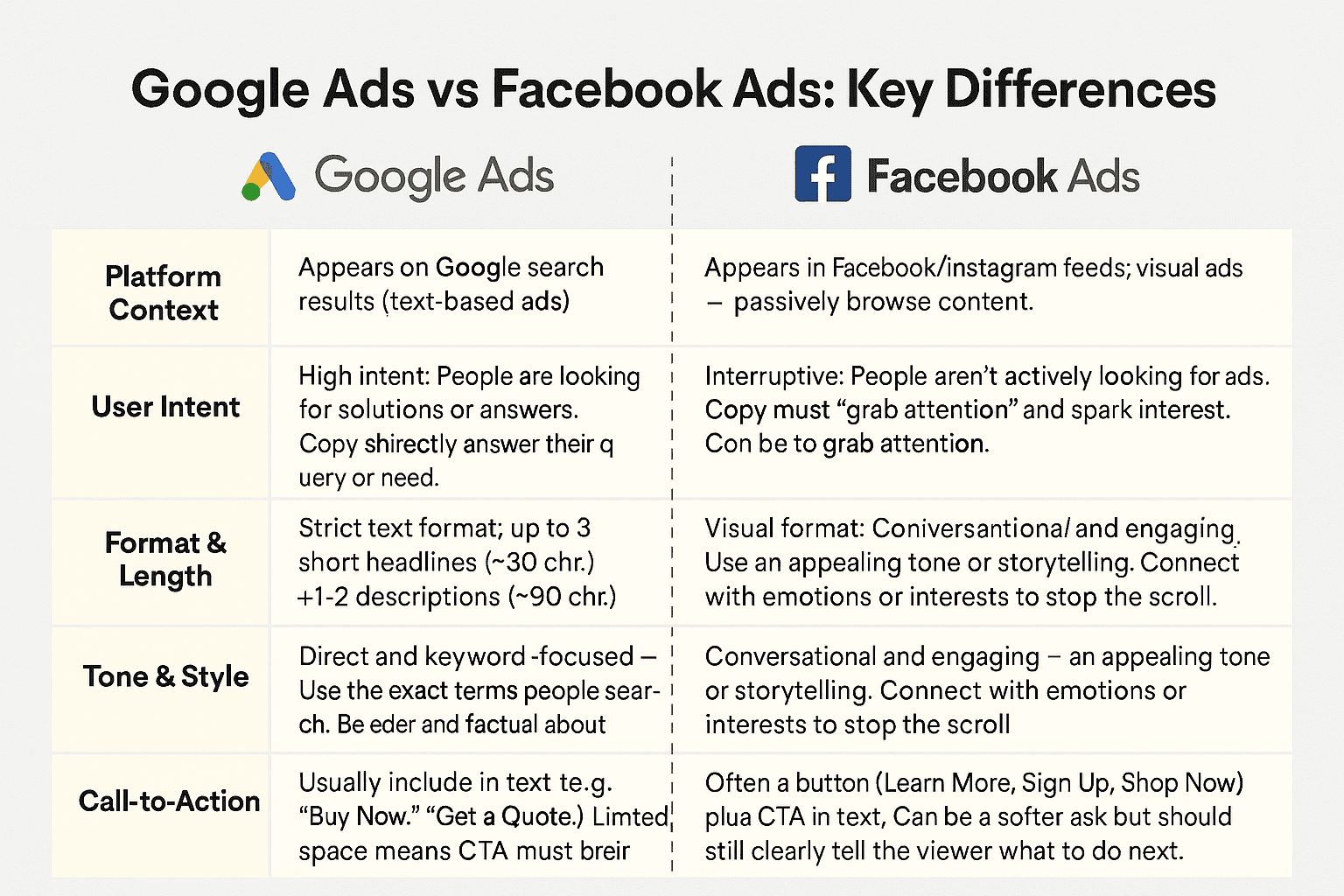
The two biggest ad platforms require slightly different copy strategies. The table below highlights the core differences without lengthy explanations:
| Feature | Google Ads (Search) | Facebook/Instagram Ads |
|---|---|---|
| Audience intent | Actively searching | Passively browsing |
| Ad format | Text‑only headlines + description | Image/video + short text |
| Character limit | ~3×30 characters + 2×90 | Only first ~125 characters visible |
| Tone | Direct, keyword‑focused | Conversational, emotional |
| Call‑to‑Action | Inside text | Button + supporting text |
SEO‑Friendly Copywriting Principles
Follow these guidelines to align your ad copy with Google’s latest ranking systems:
Write for humans first
Google’s AI overviews emphasise originality and usefulness: content should serve the reader, not manipulate algorithms.
Write in a clear, natural tone that answers questions directly, and avoid keyword stuffing. Use plain language, short paragraphs and varied sentence lengths to improve readability. Studies show that 73 % of users abandon pages with poor readability, so clarity isn’t just nice — it keeps people on your page.
Demonstrate experience and authority (E‑E‑A‑T)
Google’s ranking systems assess signals of Experience, Expertise, Authoritativeness and Trustworthiness (E‑E‑A‑T). Provide a byline and brief author bio (even in ad landing pages) to build trust.
If automation or AI was used, disclose it. Include references or testimonials that show real‑world use of your product or service. First‑hand knowledge outranks generic summaries
Optimise readability
Readable content improves engagement metrics such as dwell time and reduces bounce rates. Keep paragraphs short (one to three sentences), use subheadings, bullets and tables to break up text, and prefer active voice. Aim for a reading level around grade 6–9.When quoting numbers or statistics, place them in tables or charts to make them easier to scan.
Use keywords naturally
Keyword research still matters, but Google’s AI is shifting from simple keyword matching to understanding real‑world context and intent. Include your primary keyword (e.g., ad copywriting, Google Ads, Facebook Ads) early, especially in headings and the first paragraph.
Sprinkle variations naturally within the text, but prioritise flow over density.
Structure content logically
Organise articles with clear headings (H2, H3) and lists. Use descriptive titles that summarise what follows (“Writing Google Ads That Convert,” “Facebook Ad Templates”).
This helps both readers and search crawlers navigate your page. Structured data (like tables and schema markup) also improves visibility in AI results.
Add trust signals
Link to credible sources, cite statistics and include testimonials or case studies when possible. Trust signals—author bios, citations and structured data—help content get cited in AI Overviews. They also build reader confidence in your advice.
Writing Effective Google Ads (Search)
Google Search ads consist of up to three short headlines and two description lines. Your goal: quickly demonstrate relevance to the user’s query and entice them to click. Use these tips:
- Match the searcher’s intent – Include the keyword or search term in your first headline to show you have what they need. For example, if someone searches “budget laptop,” write “Affordable Laptop Deals” as your headline.
- Highlight your unique value – Use remaining headline slots to mention a benefit or offer (“Free Shipping”, “Award‑Winning Service”) and to add a clear call‑to‑action (CTA) like “Shop Now” or “Get a Quote.”
- Fill all fields – Use all available headline and description fields. Extra characters let you add trust signals like years in business (“Trusted Since 2010”) or customer counts (“10,000+ Clients”).
- Write concise descriptions – Use the description lines to expand on benefits and overcome objections. Keep sentences short and include the CTA again.
- Align with your landing page – Ensure the copy on your landing page mirrors your ad promise. Mismatched messaging hurts conversions and trust.
- A/B test variations – Run multiple ad versions with different headlines, benefits or CTAs. Monitor click‑through rates (CTR) and conversion rates to see which copy performs best. Even small wording changes can improve results.
Writing Effective Facebook Ads
Facebook and Instagram ads combine visuals with copy. They interrupt a browsing experience, so your first few words must hook the user:
- Start with a hook – Begin your primary text with a question, bold statement or relatable problem. For example: “Ready to double your sales?” or “Tired of cold emails that never get answered?”
- Use engaging visuals – Choose high‑quality images or short videos that illustrate your product or evoke emotion. Your image should complement your text, not repeat it.
- Keep it short and scannable – Only the first ~125 characters show without clicking “See More.” Place your most important information and keyword at the start. Break longer copy into short paragraphs or lines.
- Speak directly to your audience – Address the reader (“you”) and call out the group you’re targeting (“freelancers,” “busy parents,” etc.) where appropriate.
- Include social proof – Mention the number of users, reviews, awards or press features to build trust.
- Add a strong CTA – End with an action you want the reader to take: “Start your free trial,” “Download the app,” or “Learn more.” Use Facebook’s CTA button to reinforce the action.
- Test different hooks and visuals – Like Google Ads, experiment with multiple headlines, images and CTA combinations to see what resonates.
Copywriting Templates
Use these templates as starting points for your own ads. Replace bracketed placeholders with your product, offer and audience details.
Google Ad (Search) Template
Headline 1: [Keyword + Benefit] (e.g., “Email Marketing Software – Free Trial”)
Headline 2: [Offer or USP] (e.g., “Grow Your List Fast”)
Headline 3: [Call‑to‑Action or Trust Signal] (e.g., “Join 5,000+ Users”)
Description: “All‑in‑one solution to [solve problem]. Easy setup and 24/7 support. Try free today.”
Facebook Ad Template
Primary Text:
Hook: [Pose a question or state a pain point]
Introduce Solution: Meet [Product], a [short description] that [key benefit].
Benefit Bullets: • [Benefit 1] • [Benefit 2] • [Benefit 3]
Social Proof or Guarantee: [Number of users, awards, testimonials]
CTA: [Action you want them to take] (e.g., “Start your free trial today!”)
Headline: [Concise benefit or offer] (e.g., “Get Organized Fast”)
Description (optional): [Short tagline or reassurance] (e.g., “No credit card required”)
CTA Button: Choose from Facebook’s available buttons (e.g., Shop Now, Learn More, Sign Up).
Hypothetical Performance Comparison
Improving your ad copy can significantly boost engagement. The chart below shows a hypothetical uplift in click‑through rates (CTR) after optimising Google and Facebook ad copy. Note how the optimised versions outperform the baseline:
| Ad Type | CTR (%) |
|---|---|
| Google Ads (Baseline) | 2.5 |
| Google Ads (Optimized) | 4.1 |
| Facebook Ads (Baseline) | 1.8 |
| Facebook Ads (Optimized) | 3.3 |
Figure: Hypothetical click‑through rates before and after applying copywriting best practices. Your actual results may differ, but the trend shows how better copy can double performance.
Visual Example
The image below illustrates the concept of digital ad copywriting. Use eye‑catching visuals like this alongside your copy to draw attention and support your message:
Conclusion
Crafting high‑performing ads in 2025 isn’t about tricking algorithms—it’s about helping people. Write for your audience first, demonstrate real experience, and present your offer clearly. Use targeted keywords but prioritise readability and structure. And don’t forget to test different versions: the best copy comes from iteration. By following these guidelines and aligning with Google’s E‑E‑A‑T standards, you’ll improve your ads’ performance, satisfy users and stand out in an AI‑driven search landscape.