The enduring power of structure
Every writer knows the fear of a blank page. I felt it when I started my first blog. My mind was full of ideas, yet I didn’t know how to arrange them.
Discovering copywriting formulas changed everything. They’re not gimmicks. They’re patterns that give your words a backbone. In an age where AI can spit out paragraphs at lightning speed, these patterns help you bring intention and clarity.
Formulas free you from worrying about the order of information. Instead, you focus on the message and the reader. They allow you to tell a story with purpose rather than wandering aimlessly.
When language tools like ChatGPT joined my toolkit, I tested them on raw drafts. The sentences looked polished, yet something was missing. After applying classic formulas, the copy came alive. The structure added tension and curiosity. It felt more human.
Use formulas alongside AI to get the best of both worlds. Let the AI draft, then refine with these patterns. You’ll see how even bland text becomes engaging.
• Structure brings clarity and flow.
• Patterns prevent writer’s block and give you a starting point.
• Combining AI with formulas turns good drafts into great stories.
Why formulas still matter in the AI age
Artificial intelligence can imitate tone and rearrange words. It can’t, however, feel a deadline’s pressure or understand a customer’s frustration. Formulas add a human layer. They remind you to start with the reader’s feelings instead of your own desire to sell.
I once used an AI tool to write a product description for handmade soap. The description was technically correct but sterile. After applying the Problem‑Agitate‑Solution framework and adding tactile details about dry skin and the soothing relief of moisturized hands, conversions doubled. The formula created an emotional journey.
These frameworks are flexible. You can blend them, tailor them to different platforms and even use them to craft prompts for AI. As feeds fill with content, a well‑structured message stands out. Because formulas tap into human psychology, they remain effective despite technological change.
Consider their benefits:
• They guide your writing toward empathy and clarity.
• They adapt to blog posts, emails, social captions and ads.
• They help readers feel understood, boosting trust and action.
PAS: solve the problem you’ve stirred up
The Problem‑Agitate‑Solution (PAS) formula is a three‑step sequence built on empathy. First you name the reader’s pain point. Then you stir that pain by highlighting its impact. Finally you present your offer as the way out.
I used PAS to promote a time‑management course. Instead of starting with features, I described the chaos of juggling tasks and the anxiety of constantly running late. By the time I offered the course as the solution, readers were ready to hear me. PAS works because people act when they feel seen and understood.
Here are the steps:
- Describe the problem clearly.
- Agitate the emotion by showing what happens if nothing changes.
- Present your product or idea as the solution.
Use PAS in emails, landing pages and social media captions. It connects directly to the reader’s current state and gently guides them toward a better future.
AIDA: guide attention to action
Attention, Interest, Desire, Action (AIDA) mirrors how people make decisions. You start by grabbing attention with a hook. Next you build interest with facts or benefits. Then you stir desire by painting a picture of a better life. Finally you invite action with a clear call to act.
When I wrote an ad for a productivity app, I opened with a question: “Tired of feeling overwhelmed by your to‑do list?” That hook captured attention. I followed with a statistic about hours saved each week and described the relief of organized tasks. I closed with a simple call to action: “Try it free for seven days.” The ad beat the previous version, which listed features without structure.
AIDA is adaptable. In a single headline, each stage might be a phrase. In a webinar, each stage could fill several minutes. The goal is to move the reader through all four phases without skipping any.
Tips for using AIDA:
• Craft a hook that stops the scroll.
• Share facts that build interest and trust.
• Describe the reader’s future state to create desire.
• End with a clear and simple action step.
BAB and FAB: showing transformation and benefits
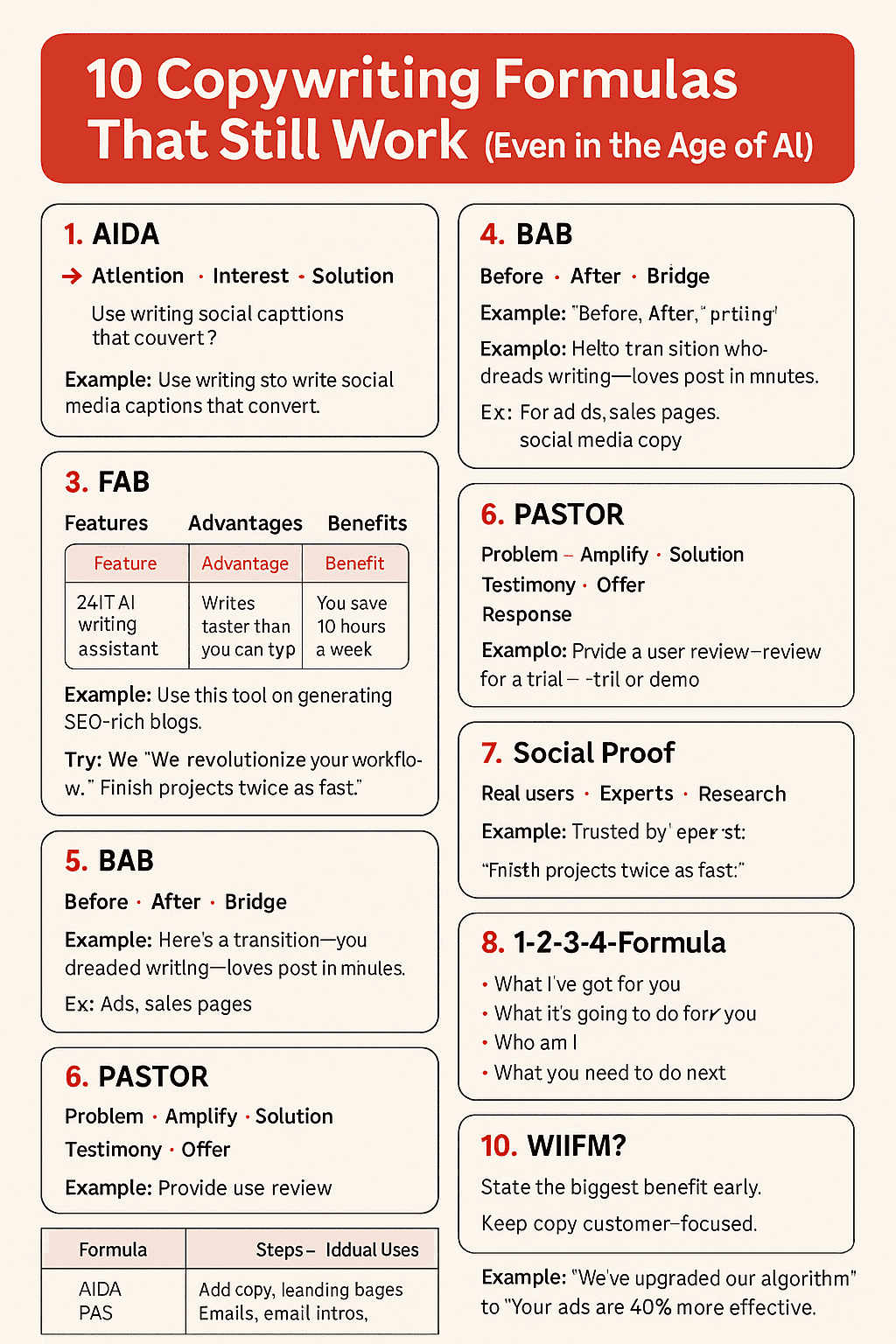
The Before‑After‑Bridge (BAB) formula is ideal when you want to show transformation. You start with the reader’s current state (“Before”), then paint a picture of their desired outcome (“After”). The Bridge is your product or service, showing them how to get there.
I used BAB to sell a fitness program. In the “Before” scene, participants felt sluggish and out of shape. The “After” scene showed them climbing stairs with ease and feeling confident at the beach. The Bridge was a 30‑day workout plan. Readers related to both states and saw the program as their path forward.
The Features‑Advantages‑Benefits (FAB) formula forces you to translate product specs into human outcomes. Businesses often list features that readers may not care about. FAB helps you connect the dots.
- Feature: what your product does.
- Advantage: how the feature helps the reader.
- Benefit: why it matters in the reader’s life.
Example: For a noise‑canceling headphone, the feature is active noise cancellation. The advantage is blocking ambient noise on busy commutes. The benefit is being able to focus on your favorite podcast without distractions.
Use BAB when you need to show a journey from problem to solution. Use FAB when you want to translate technical terms into human value. Combine them to create powerful narratives that speak to both emotion and logic.
The Four C’s and the 4 P’s: clarity over clutter
The Four C’s formula helps you write messages that get read. It stands for Clear, Concise, Compelling, Credible.
• Clear: Your point is instantly understood.
• Concise: You respect the reader’s time and cut fluff.
• Compelling: You appeal to emotions and curiosity.
• Credible: You back up claims with facts, testimonials or data.
I used the Four C’s when writing a landing page for an online therapy service. We avoided jargon, trimmed unnecessary phrases, added a heartfelt testimonial and highlighted the therapist’s credentials. The sign‑up rate increased because visitors felt informed and reassured.
The 4 P’s formula — Promise, Picture, Proof, Push — builds trust and urgency.
• Promise: Make a bold, relevant promise to the reader.
• Picture: Paint a vivid picture of success.
• Proof: Provide evidence through statistics or stories.
• Push: Ask the reader to act with a clear call to action.
I used the 4 P’s in a script for a language‑learning app. We promised fluency in three months, showed visuals of users speaking confidently abroad, shared data on completion rates and ended with a clear “Download now” instruction. The combination of vision and proof built trust.
Both formulas encourage brevity and structure. They push you to cut clutter and deliver your message with impact.
Storytelling: turn readers into heroes
Humans remember stories better than lists. The Hero’s Journey, a narrative framework, adapts well to marketing. Your customer is the hero. Your product is the guide.
The arc follows this path:
• Ordinary world: The hero starts in a familiar situation with a problem.
• Challenge: They face a specific obstacle.
• Mentor: They meet a guide (your brand) with the solution.
• Transformation: They apply the solution and return transformed.
I tested this approach in a case study for a software company. Instead of listing features, we told the story of a client who struggled with manual data entry. The software automated tasks and freed up time. The client then launched new projects and grew revenue. Readers saw themselves in the hero’s role, making the message more memorable.
Use storytelling on landing pages, in video scripts and even in short social posts. Hinting at a journey can make a single sentence feel like part of a bigger story.
ACCA and the “So What?” test: guiding comprehension and conviction
Awareness, Comprehension, Conviction, Action (ACCA) moves readers from awareness to action.
• Awareness: Introduce the topic or problem.
• Comprehension: Explain the details and implications.
• Conviction: Use emotion and proof to persuade.
• Action: Tell readers what to do next.
I followed ACCA in a blog post about sustainable fashion. The introduction raised awareness of fast fashion’s environmental impact. The body explained why it matters and shared worker stories. Conviction came through statistics and brand examples. The conclusion invited readers to shop ethically with links to fair‑trade brands. The step‑by‑step flow increased time on page and social shares.
The “So What?” test is a simple editing tool. After each sentence, ask yourself: “So what?” If the sentence doesn’t move the reader closer to understanding or action, cut or revise it. I used this test in an email campaign for a nonprofit. Removing two paragraphs that added context but not persuasion led to higher donations. It’s especially useful when AI‑generated text becomes wordy.
The You Formula and social proof: make it about them
Count how many times you use “you” versus “we” or “I” in your copy. Readers care about themselves. The You Formula is about speaking directly to them.
When I rewrote a client’s homepage using this guideline, I shifted from “We design beautiful websites” to “You get a website that turns visitors into customers.” That small change lowered the bounce rate. People felt the site was talking to them rather than boasting about itself.
Forms of social proof include:
• Testimonials: quotes from happy customers.
• Case studies: stories about real results.
• Endorsements: recommendations from authorities or influencers.
• Numbers: how many people use or trust your product.
Social proof can stand alone or weave into other formulas. Use a testimonial as proof in the 4 P’s or as credibility in the Four C’s. When AI writes generic praise, specific voices from real people build trust.
Putting it all together: a quick reference
The table below summarizes the ten formulas and where they shine:
| Formula | Steps | Ideal use cases |
|---|---|---|
| PAS | Problem → Agitate → Solution | Emails, landing pages, ads |
| AIDA | Attention → Interest → Desire → Action | Sales pages, video scripts, social captions |
| BAB | Before → After → Bridge | Story‑driven promos, lifestyle products |
| FAB | Feature → Advantage → Benefit | Product descriptions, presentations |
| Four C’s | Clear → Concise → Compelling → Credible | Homepages, brochures, service pages |
| 4 P’s | Promise → Picture → Proof → Push | Video ads, webinars, sales letters |
| Storytelling (Hero’s Journey) | Ordinary world → Challenge → Mentor → Transformation | Case studies, brand narratives |
| ACCA | Awareness → Comprehension → Conviction → Action | Educational content, long‑form articles |
| So What? test | Evaluate each sentence’s relevance | All copy; editing tool |
| You Formula & Social Proof | Use “you” language; show evidence | Homepages, testimonials, social proof sections |
Experiment and adapt
These frameworks are recipes, not rules. Mix and match them based on your goals. A social caption might start with a PAS hook and end with a mini AIDA sequence. A sales letter might weave storytelling with FAB to show both journey and benefits.
As technology evolves, empathy and clarity will remain valuable. Formulas help you harness those qualities. Use them as foundations for your drafts, whether written by a human or AI. Test your messages in real life and see what resonates. The more you experiment, the better you’ll get at crafting copy that connects.